

Key Takeaways
- Only 25% of talent acquisition leaders rate their current technology as very effective for high-volume hiring, showing most tools underdeliver.
- 46% of sourcing teams across two separate surveys described their current sourcing tool as somewhat or not at all effective, adoption has outpaced satisfaction.
- AI sourcing tools draw from massive databases (hundreds of millions of profiles), but scale alone doesn't fix accuracy or engagement problems.
- AI is strongest at narrowing a candidate pool quickly; it's weakest at writing outreach that doesn't sound robotic or at replacing recruiter judgment.
What AI candidate sourcing actually means
AI sourcing isn't one single feature or tool. It's a set of distinct capabilities, including resume parsing, semantic matching, ranking algorithms and automated outreach, that work together to surface and prioritize candidates faster than manual search (aihr.com). Some vendors bundle all of this under one marketing label, which makes it hard to tell what a product genuinely automates versus what still needs a recruiter's judgment. Real AI sourcing functionality includes enrichment, where scattered data points are pulled into a single candidate profile, and matching, where open roles are scored against that profile using skills and experience signals.
Buzzwords like "AI-powered" or "smart sourcing" don't guarantee any of this is happening under the hood.
Genuine systems improve measurable outcomes, not just interface polish. Candidate experience is one place the difference shows: Metaview reported an NPS shift from -45 to +1 after applying AI to its hiring workflow (Metaview, 2026). That kind of shift separates functional sourcing tools from relabeled search boxes.
Why recruiters are turning to AI sourcing now
Hiring volume keeps growing while sourcing teams stay flat. Recruiters are expected to fill more roles with the same headcount, and manual searching across job boards and resume databases simply cannot scale at that pace. Talent leaders overwhelmingly recognize the stakes, with many noting a gap between the value of active sourcing and how most hires actually happen (onrec.com). That gap between strategic intent and daily practice is pushing teams toward automation that can proactively surface candidates rather than wait for applications.
The effectiveness gap compounds the pressure. Only 25% of talent acquisition leaders rate their current technology as very effective for high-volume hiring (Aptitude Research, 2026).
That leaves most recruiting functions relying on tools that quietly underperform at scale, which is exactly the problem AI sourcing is being adopted to close.
Where AI sourcing genuinely saves time
Automation removes the repetitive first pass of sourcing. Scanning thousands of profiles against a role's baseline requirements is mechanical work, and software does it without fatigue or drift in attention. Greenhouse reported a 70% reduction in sourcing time using similar AI automation (codewords.ai). That figure reflects the early funnel, not final hiring decisions
recruiters still own the judgment calls that follow.
Profile ranking and shortlisting
Ranking tools sort candidates by keyword match, experience signals, and activity patterns far faster than manual review. A recruiter can glance at a pre-sorted list instead of reading hundreds of resumes line by line. This doesn't guarantee the top-ranked profile is the best fit, but it narrows the pool quickly.
First-pass outreach drafting
Drafting the first outreach message is another place where automation earns its keep. Templates personalized with scraped profile data give recruiters a starting point instead of a blank page. Many search firms already lean on software for this kind of volume work: Recruiterflow says over 2,100 search firms use its platform (Recruiterflow, 2026). The message still needs a human edit before it goes out.
Where AI sourcing still falls short
Automation can't fix a message no one wants to read. Nearly half of talent leaders surveyed, 46%, said their current sourcing tools were ineffective, a figure that undercuts the idea that AI alone solves the sourcing problem (Onrec, 2025). Candidates can tell when a message was generated rather than written, and many disengage once they spot the pattern. Recruiters describe spending as much time editing AI-drafted InMails as they would have spent writing one from scratch.
LinkedIn Recruiter's built-in AI search often returns broad, loosely relevant pools rather than tightly matched candidates.
That gap between promise and precision is exactly why benchmarking matters before trusting any tool's output.
Sourcing still depends on judgment about fit, tone, and timing that a model can't fully replicate. Teams rethinking talent acquisition strategy are learning to treat AI as a first-pass filter, not a finished pitch (TestGorilla).
AI sourcing vs. traditional database search
Bigger databases don't automatically mean better matches. AI-driven platforms now pull from enormous pools of candidate profiles, with Juicebox.ai citing over 800 million global profiles (juicebox.ai) and HireEz drawing on 700M+ profiles across more than 30 platforms (dishertalent.com). Traditional Boolean search works from a narrower, manually queried set of sources.
Scale changes what a tool can reach, not whether what it finds actually fits the role.
| Approach | Strength | Limitation |
|---|---|---|
| AI-driven matching | Faster first-pass filtering | Still needs human review of fit |
| Traditional Boolean search | Precise, controllable queries | Slow, skill-dependent |
| Large profile databases (800M+, 700M+) | Broad reach across platforms | Volume doesn't guarantee accuracy |
Recruiters weighing these options should treat database size as one input among several. A Boolean query built by an experienced sourcer can outperform a wide AI sweep on a narrow, specialized role. The reverse holds true for high-volume hiring where speed matters more than precision.
Data accuracy: the hidden weak point
A sourcing tool is only as good as its data freshness. Algorithms can rank and filter candidates brilliantly, but if the underlying records are outdated, duplicated, or disconnected from a company's actual CRM or ATS, every recommendation inherits that rot. Buyers tend to judge sourcing platforms on search speed and match quality while ignoring the quieter question: does this tool know what's already sitting in our own database? That gap creates hidden costs later, when teams discover they've re-sourced people already in the pipeline or reached out to contacts with stale job titles.
Migration and integration issues compound the problem.
A clean demo database rarely reflects the messy, years-old records most organizations actually run on.
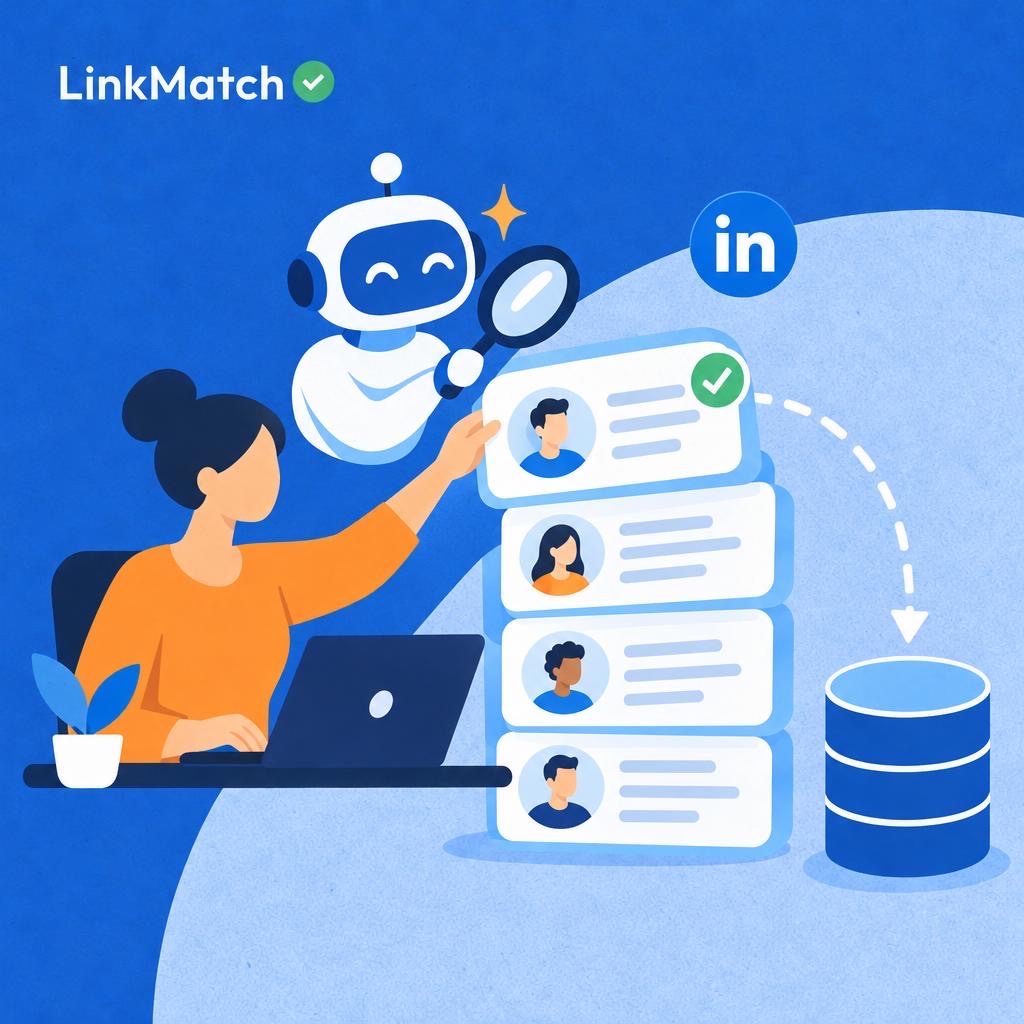
In practice, tools like LinkMatch address this directly by checking a sourced LinkedIn or XING profile against existing CRM records and showing a green checkmark or red cross on the spot. That instant match detection stops duplicate entries before they form and surfaces stale records for review, closing the accuracy gap other sourcing tools leave open.
Keeping your CRM or ATS honest about who's already in it
Sourcing more candidates means more data to manage. Every new name an AI tool surfaces has to land somewhere, and that somewhere is usually a CRM or ATS that already holds thousands of records. Recruiters end up toggling between LinkedIn tabs and database screens, manually retyping names, titles, and contact details. That context-switching is where duplicate profiles, missed updates, and outdated statuses creep in.
The more candidates flow in, the harder manual entry is to sustain without errors.
Closing that loop matters more than finding candidates in the first place. In practice, tools like LinkMatch let recruiters add a new LinkedIn contact straight into their CRM or ATS with one click, skipping the copy-paste step entirely. That keeps records current without forcing anyone to choose between sourcing speed and database accuracy.
A clean system isn't a side benefit. It's what makes every sourced candidate actually usable later.
Compliance and bias considerations
Scraped contact data carries real legal exposure. Collecting names, emails, or phone numbers without a lawful basis can breach privacy frameworks such as GDPR or state-level data laws, exposing recruiters and vendors to fines and takedown demands. Storing stale or inaccurate records compounds the risk
a mismatch between consent and reuse can trigger complaints even when the original scrape was legal.
Bias is a separate but related problem. Sourcing tools trained on historical hiring data can quietly favor candidates who resemble past hires, narrowing the pipeline by gender, age, or background. Unchecked automation can scale that bias faster than a human team ever would.
- Consent trail: confirm where each contact detail originated.
- Retention limits should be enforced so stale candidate data is purged automatically.
- Audit sampling: periodically review outreach lists for demographic skew.
- Vendor contracts ought to specify who owns liability for sourced data.
How to evaluate an AI sourcing tool before buying
Test accuracy and integration before committing to a contract. A vendor demo tells you almost nothing about how a tool performs against your actual hiring needs, so lean teams should run trials on live, open roles instead of polished sample data. Nearly half of sourcing teams, 46%, said their current sourcing tool was somewhat or not at all effective (TestGorilla, 2025), which makes a hands-on evaluation before purchase worth the extra time. Hiring managers without a dedicated recruiting ops function carry the most risk from a mismatch, since there's no second team to catch problems later. A structured checklist turns a sales pitch into a measurable test. Our wider comparison of candidate sourcing tools that fix pipeline problems applies the same criteria.
- Request a trial using your actual open roles, not vendor demo data
- Check how the tool handles duplicate profiles already sitting in your CRM or ATS
- Ask how contact data is sourced and how frequently it gets refreshed
- Pricing models vary widely between per-seat and credit-based structures, so confirm what happens as usage scales
- Integration depth with your existing systems often determines daily adoption, a factor covered in pin.com's Recruiting Tech Stack Report
Common mistakes when adopting AI candidate sourcing
- Treating AI output as final, not a first pass: AI-ranked candidates and drafted messages still need recruiter judgment and editing before they go anywhere near a real outreach send.
- Ignoring duplicate and stale data created by new sourcing volume: Sourcing more candidates faster just multiplies the manual cleanup problem if there's no system flagging who's already in your CRM or ATS.
- Choosing a tool based on database size alone: A larger profile count doesn't guarantee better matches or more accurate contact details, as effectiveness surveys consistently show.
- Expecting chatbots to replace candidate relationships: Candidates routinely react poorly to automated engagement that feels impersonal, undermining the trust sourcing is meant to build.
FAQs about AI Candidate Sourcing
What AI tools do recruiters actually use for sourcing candidates?
Recruiters typically rely on a mix of database-matching platforms that scan resumes and profiles for relevant keywords and skills, enrichment extensions that pull contact details and additional context on candidates, and outreach drafting tools that help write initial messages. Each tool handles a narrow piece of the sourcing workflow rather than the whole process.
Are AI chatbots effective for candidate engagement?
Results are mixed. Chatbots can handle basic scheduling and screening questions, but many candidates still prefer speaking with a human recruiter, especially as conversations get more detailed or personal. This means chatbots work better as a supplement to human outreach rather than a full replacement.
Do AI sourcing tools actually improve response rates?
It depends on the tool and how it's used. Some recruiters see better engagement with AI-assisted outreach, others don't notice a difference, and there isn't a single consistent uplift figure that applies across tools or industries. Results vary enough that outcomes should be evaluated case by case rather than assumed.
Is AI candidate sourcing reliable enough to replace manual search?
No. AI sourcing tools are useful for speeding up the early stages of finding candidates, but they still require manual review and recruiter judgment to catch mistakes, verify fit, and handle nuance that the tools miss. The most effective approach combines AI assistance with hands-on vetting rather than relying on automation alone.
Sources
Stop wasting hours copying candidate data from LinkedIn to your ATS.
LinkMatch instantly syncs LinkedIn profiles with your ATS in one click so you can focus on building relationships instead of manual data entry.
Get the Chrome Extension