

Key Takeaways
- Only 25% of talent acquisition leaders rate their technology as very effective for high-volume hiring, so bigger databases alone don't solve sourcing problems.
- 46% of sourcing teams in two separate surveys called their current sourcing tool somewhat or not at all effective, pointing to a widespread satisfaction gap rather than a tool-specific flaw.
- Database size (700M, 800M+ profiles) matters less than search precision; one benchmark reported 93.5% sourcing precision on a 1,400-query test, a more useful comparison point than raw profile counts.
- Vendor-reported time-to-hire gains vary widely (from a claimed 70% cut to a drop from 44 days to 2 weeks), so treat single-vendor case studies as directional, not universal.
Why Most ATS Platforms Fall Short on Sourcing
Most ATS platforms track applicants, not source them. These systems were built to manage candidates who already applied, organizing resumes, scheduling interviews, and logging status changes. Sourcing requires something different: finding and engaging people who haven't applied at all. That mismatch shows up clearly in the data, with only 25% of talent acquisition leaders rating their technology as very effective for high-volume hiring (Aptitude Research, 2025). Three out of four leaders are relying on tools that weren't designed for the problem they're trying to solve.
Nearly half of sourcing teams report the same disconnect, with 46% saying their current sourcing tool was somewhat or not at all effective (TestGorilla, 2025).
That gap persists even as hiring volume climbs and competition for candidates intensifies. An ATS can store a pipeline, but it can't build one from scratch. Treating applicant tracking software as a sourcing engine leaves recruiters doing manual outreach work the platform was never built to automate. See how dedicated candidate sourcing tools fix pipeline problems an ATS leaves open.
What a Sourcing-Focused ATS Actually Needs
Search depth and data freshness separate sourcing tools from systems that only store applications after the fact. A true sourcing platform lets recruiters filter candidates by skills, seniority, location and career trajectory rather than relying on a single keyword box.
It also keeps contact records current, so an email found six months ago still reaches a working inbox today. Without these two qualities, a tool becomes a filing cabinet rather than a pipeline builder, and recruiters end up exporting lists into separate software just to do the actual sourcing work.
- Searchable candidate database with filters beyond keyword matching, including boolean logic, tenure ranges and skill adjacency.
- Contact enrichment: verified email and phone data that gets refreshed rather than scraped once and left stale.
- Automated outreach sequencing built directly into the workflow, so follow-ups fire without manual tracking in spreadsheets.
- Pipeline sync: two-way updates between sourcing activity and existing recruiting stages, not a one-way data dump.
- Compliance controls governing how contact data is collected, stored and deleted across jurisdictions.
- Audit trails showing where each candidate record originated, useful when data-sourcing practices are questioned.
Database Size vs. Search Precision
Bigger databases don't guarantee better search results. Juicebox.ai lists over 800 million global profiles (juicebox.ai), while HireEz draws from 700M+ profiles spanning more than 30 platforms (dishertalent.com). Neither figure says anything about how accurately those records surface the right candidate for a given query. Metaview took a different approach, reporting a 93.5% sourcing precision score on a 1,400-query benchmark (metaview.ai). That number measures match quality directly, rather than counting how many records a tool can claim.
| Metric | Vendor | Figure |
|---|---|---|
| Global profiles | Juicebox.ai | 800 million |
| Database profiles | HireEz | 700M+ across 30+ platforms |
| Sourcing precision benchmark | Metaview | 93.5% on 1,400-query test |
Scale and precision answer different questions.
One tells you how much is stored; the other tells you how well it's retrieved. These three figures come from separate vendors and separate testing methods, so they shouldn't be read as a single ranking.
AI Sourcing Features That Hold Up Under Scrutiny
AI sourcing claims deserve a skeptical first look. Recruiters on forums regularly describe generic InMail drafts that need heavy rewrites and chatbot screeners that irritate candidates before a human ever speaks with them. Those complaints are fair, and they point to a real gap between marketing copy and daily use. But not every AI feature deserves the same skepticism, and candidate-experience data from Metaview shows one area where measured improvement actually happened: a shift in candidate NPS from -45 to +1 (Metaview). That move from deeply negative to barely positive is modest, not transformative, and should be read as such.
Where AI genuinely saves time
Sorting large applicant pools, surfacing resume keywords, and scheduling early-stage calls are tasks AI handles reliably. These are repetitive, rule-based jobs where speed matters more than nuance.
Recruiters get hours back without losing much accuracy on the easy filtering layer.
Where human review still matters
Outreach messaging, culture-fit judgment, and final candidate conversations still need a person. Template-heavy InMail drafts read as impersonal, and that's often exactly why candidates disengage.
The Metaview NPS shift suggests thoughtful AI design paired with human oversight can nudge experience in the right direction (AI Hiring Tools), but it's not a substitute for a recruiter closing the loop.
Integration and Data Accuracy Risks to Watch
Switching platforms often exposes hidden data problems. Migrating candidate records between systems frequently surfaces duplicate profiles, mismatched fields, and stale contact details that were quietly tolerated under the old setup. Recruiting teams expect faster sourcing after a new tool goes live, but the first weeks are often spent reconciling conflicting records instead
this gap between promised efficiency and real output is a major reason sourcing teams keep calling their tools ineffective, even when adoption rates look strong on paper (testgorilla.com).
Active sourcing is widely viewed as essential to filling roles, yet most hires still come through passive channels, which means sourcing data has to stay clean across both pipelines at once (onrec.com). Every unflagged duplicate adds friction to that balancing act.
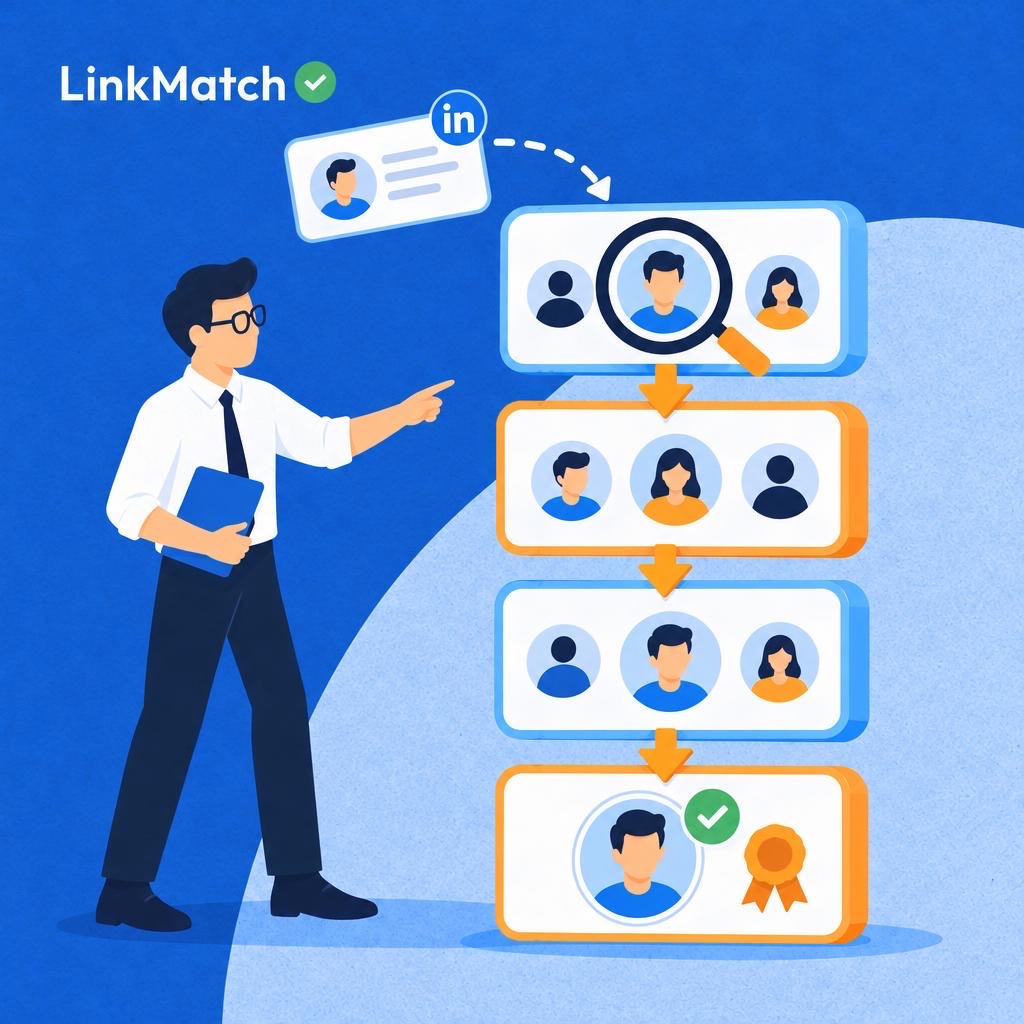
In practice, tools like LinkMatch address this directly with a green checkmark or red cross indicator that instantly shows whether a sourced profile already exists in the CRM. That single signal prevents duplicate records from piling up and keeps candidate data trustworthy as teams move between systems. For the full workflow, see how to add LinkedIn candidates to your ATS.
Time-to-Hire Impact of Sourcing Automation
Automation claims vary widely across vendor reports. Greenhouse reported a 70% reduction in sourcing time using similar AI automation (codewords.ai), while a separate seed-round announcement cited the same 70% figure for cutting overall time to hire by expanding candidate profiles and suggesting next actions (Recruiter Preston, 2026). A third claim, pulled from a vendor brief, described customers moving from an average 44-day hiring cycle down to just 2 weeks (Recruiter Preston, 2026). These numbers come from different companies, different methodologies, and different definitions of "time saved, " so they should be read as vendor-reported marketing figures rather than as a universal benchmark any team can expect to replicate.
| Claim | Result | Source |
|---|---|---|
| Sourcing time reduction | 70% | Greenhouse, 2024 |
| Time-to-hire cut (seed announcement) | 70% | Pin, via Recruiter Preston |
| Average time to hire | 44 days to 2 weeks | Recruiter Preston |
Treat each figure as a single data point tied to one vendor's customer base, not an industry average.
Compare any pitched outcome against your own current time-to-hire baseline before assuming similar gains.
Pricing Models: Credit-Based vs. Per-Seat
Credit-based pricing can hide the true sourcing cost. A tool that charges per credit looks cheap until a recruiter burns through an entire monthly allotment chasing a single hard-to-fill role. Per-seat pricing feels predictable on paper, but idle licenses for hiring managers who log in twice a month quietly inflate the bill. Lean teams need to model both against actual usage patterns, not list price alone.
Credit systems reward disciplined searching and punish exploratory sourcing, which is common when a role's requirements are still vague.
Per-seat plans reward teams that onboard every stakeholder but waste money on light users who barely touch the platform.
The real comparison is cost per qualified candidate surfaced, not cost per license or credit. A five-person team doing high-volume sourcing may spend less on a well-managed credit plan than on five full seats. A founder hiring occasionally may find a single flexible seat cheaper than any credit package. Run both models against your last quarter's actual hiring volume before signing a yearly contract.
How to Evaluate an ATS Before You Switch
A short trial period reveals more than a demo. Vendor demos run on curated sample data designed to flatter search results, which tells a recruiter nothing about how the tool behaves against a messy live pipeline. Active sourcing remains a core part of recruiting work even when teams are frustrated with their current platform, so the switching decision deserves a structured test rather than a gut call based on a sales pitch.
- Test search precision using real open roles instead of sample data, then judge candidate relevance against actual hiring criteria.
- Check contact enrichment accuracy by running known profiles through the tool and comparing results to verified information.
- Confirm two-way sync with existing pipeline tools so sourced candidates and status updates flow without manual re-entry.
- Ask for a trial window long enough to complete a full sourcing cycle, from first search through outreach and response.
- Review data compliance policies covering sourced contact information, including storage location and consent handling.
- Time how long it takes a sourced profile to become a usable record in your system. In practice, tools like LinkMatch add profiles to a CRM or ATS with custom fields in one click, which is a concrete way to measure whether a platform actually cuts manual data entry.
Common Mistakes When Choosing an ATS for Sourcing
- Judging tools by database size alone: A larger profile count doesn't guarantee better search precision or more relevant results for your specific roles.
- Skipping a real-world trial run: Demos rarely reveal integration friction or data accuracy issues that only surface during an actual sourcing cycle.
- Trusting vendor time-to-hire claims at face value: Reported gains vary widely across vendors and use cases, so treat them as directional rather than guaranteed outcomes.
- Ignoring hidden integration and migration costs: Switching platforms can introduce data loss or duplicate records if sync and migration aren't planned carefully.
FAQs about Best Applicant Tracking System for Candidate Sourcing
What AI tools do recruiters use for sourcing candidates?
Recruiters typically rely on a combination of database search tools to find candidate profiles, enrichment add-ons that fill in missing contact details and background information, and outreach automation tools that handle initial messaging and follow-ups at scale.
Are AI chatbots effective for candidate engagement?
Reception is mixed. While chatbots can handle scheduling and basic Q&A efficiently, many candidates still prefer human contact during early-stage outreach, so relying solely on automated engagement can hurt the candidate experience.
Is a bigger candidate database always better?
Not necessarily. A larger database doesn't guarantee better sourcing outcomes. Precision in matching relevant candidates matters more than sheer volume, so it's worth running benchmark tests against your actual hiring needs before choosing a platform based on database size alone.
How reliable are vendor time-to-hire claims?
Time-to-hire improvements vary significantly by vendor and depend on factors like company size, role complexity, and existing processes. These claims should be treated as directional indicators rather than guaranteed results for your organization.
Sources
Tired of Manually Copy-Pasting LinkedIn Profiles Into Your ATS?
Stop wasting hours on manual data entry and eliminate costly human errors. Instantly sync candidate profiles, resumes, and contact info from LinkedIn directly into your ATS with a single click.
Automate Your Candidate Sourcing